

Are you dreaming of visible, sculpted core muscles? To get there, you should introduce a properly developed ABS workout into your training routine – we've known for quite a while now that ordinary crunches
Activity zone 4F
In this zone, your heart rate rises at the mere thought of the next workout. You'll find the best ways to exercise effectively, discover new disciplines, and choose an outfit that suits your needs. We'll also guide you through the clothing care process and advise what to buy for enthusiasts of various sports. Our blog is a guide for everyone who wants to feel motivation 4 times more!
Published: 9/12/2024🏋 Fitness
)
)
)
)

)
)

)
)
)
)

)
)
)
)

8 principles of a good kettlebell workout and an exercise set for beginners

A kettlebell workout will help you build muscle mass and strength – it's also a great idea to add variety to your at-home workouts. They are not as popular as dumbbells and other accessories, but have been known practically from time immemorial. Want to try exercising with kettlebell? See the best beginner workout, find out what the effects are and learn the basics to minimise the risk of injury.
In this article:
-
Kettlebells are functional training equipment that engages the entire body.
-
Kettlebell exercises help build strength, endurance, coordination, balance, and fitness.
-
Before starting kettlebell training, you should learn the correct technique for performing the exercises.
-
You should choose the right kettlebell weight for your strength and type of training.
-
You should warm up and stretch before and after training.
Short summary:
Kettlebell – choosing the right one and a brief history
The history of the kettlebell is not entirely clear. References to training equipment of similar design appear as far back as in Ancient Greece. Training with shi shou, also known as stone castles, was popular in ancient China. They are not round, but the resemblance is apparent, especially in terms of the form of training.
The first official mention of the kettlebell appears in 1704 in a Russian dictionary, which is why Russia is often considered as the origin country of this training. Over time, the shape of the accessory changed – in 1880 it was even part of the Russian army's training, and in 1885 professional kettlebell lifting emerged. It wasn’t until the early 20th century that it entered the picture in the United States.
Kettlebell types:
-
composite,
-
vinyl,
-
cast iron – extremely durable, likely to last for years to come,
-
rubber-coated cast iron – one of the most popular types of kettlebell that protects the floor from damage,
-
composite bitumen.
When choosing a kettlebell, pay attention to the quality of workmanship – the surface has to be smooth, especially the handle, which should not be rubber-coated. This reduces the range of movement and renders it impossible to perform many exercises correctly. A kettlebell’s proper shape is significant, as it allows you to do many extra exercises. Pay attention to the handle and horn – they should be large enough for you to allow grabbing them with both hands at the same time.

)
)
)
)
)
)
)
)
)
)
)
)
)
)
)
)
£17.38
£17.38
£17.38
)
)
)
)
)
£28.74
)
)
Benefits and results of kettlebell training
Do you already have gliding discs, dumbbells, a barbell or other training accessories at home and are wondering if it's worth adding more equipment to your home gym? Find out the key benefits of kettlebell training, which will answer the question of whether it is something for you:
-
activation of deep muscles – when you put the kettlebell in motion, you need to lock in your core and work with it really hard – this will help alleviate back pain, improve stability and strengthen your spine,
-
improved muscle strength and endurance – kettlebell exercises require constant muscle tension,
-
improved balance and coordination – your muscles will be forced to constantly balance, thus strengthening the muscle tissue, tendons, and ligaments,
-
perfect equipment for people with muscle imbalance, postural defects and other functional disorders,
-
improved physical fitness and strengthened cardiovascular system – kettlebell training provides other type of physical exertion compared to traditional strength training. It’s recommended to follow the weight training with elements of endurance and cardio workouts, which have an excellent effect on the cardiovascular system. With such exercises, you can get your heart beat to over 60% of your max heart rate, making it a significant form of a cardio workout,
-
recommended to both men and women – research shows that it improves endurance and strength regardless of sex, with heavier weights (e.g. 16 kg) bringing results faster,
-
improved body appearance – this type of training requires the entire body to work globally, and the more muscles you engage, the greater the fat reduction and the faster your metabolism,
-
you can complete the entire workout at home and also take it with you while travelling.
)
)
)
)
)
)
)
)
)
)
)
)
)
)
)
)
)
)
)
)
)
)
)
)
)
)
)
)
)
)
)
)
)
)
)
8 principles of a good workout
Here's a set of basic kettlebell training rules you should know before you start your kettlebell adventure.
Rule #1 – A kettlebell is not a dumbbell
A kettlebell is not a dumbbell and cannot be treated as such, as both pieces of equipment engage muscles differently.
The kettlebell is used for functional full-body exercises rather than working on small muscle groups, where dumbbells work perfectly – it also has a shifted centre of gravity, which affects the training technique. Of course, you can even perform a biceps curl with it, but it is not intended for that purpose.
Quantity repetitions aren’t the aim of a workout. Working on technique and weight is – the repetition range always depends on the purpose of the training, but it is impossible to simultaneously work on endurance, strength and hypertrophy in the same series.
Rule #2 – Learn proper technique and exercises
First of all, mind your wrists – your forearms and hands should form a line. As in martial arts, you can't relax your wrist as it might result in arm fracture – never bend it while working out. When exercising with a kettlebell, the weight usually rests on the forearm, so if you bend your wrist dorsally, you increase the tension – when you add to that a dynamic movement, you can get injured easily.
Rule #3 – Decide which workout style you choose
Before you start training, you should decide which workout style would be the most beneficial to you. We distinguish Hardstyle Snatch and Kettlebell Sport Snatch. In the first case, you focus on developing strength, power, body endurance and thorough technique exploration. You perform more repetitions at a lower intensity and the series are long. In the latter case, you train for speed and strength. It’s a low-rep workout at high intensity with heavy weights. The main aim is to optimise speed and power.
Rule #4 – Choose the right weight
What kettlebell weight should I choose to start with? The most popular are 4 kg, 8 kg, 10 kg, 12 kg and 16 kg kettlebells. Pick a weight that is aligned with your strength, as well as workout type – a different weight will work for static or dynamic workout, while another one is better for arm or leg muscles.
To start with, it's worth choosing two different kettlebells and grow your collection over time – the first one might weigh 4-8 kg and the second 8-12 kg. The rule of the thumb is: choose a kettlebell that you can bring to shoulder height using both hands.
Rule #5 – Don't forget to warm up and stretch
Before training, do a dynamic warm-up to prepare your body for exercise. Circuit training with kettlebells engages the whole body, so make sure you stretch properly after the workout. Exercises that strengthen your abs and back muscles are also recommended to improve your core strength.

)
)
)
)
SPEED HIKER Women's Low Sneakers - Gray
View productWomen's casual crew socks (3-pack) - white
View productRule #6 – Learn to breathe properly
Correct breathing is crucial in kettlebell exercises – take a deep breath as you swing the weight towards your body, exhale as you push your hips out and let the kettlebell fly up in front of you. If you are doing the overhead press, exhale when lifting, inhale when lowering the weight down. Correct breathing technique helps minimise the risk of injury and makes the results of your kettlebell training noticeable sooner.
Rule #7 – Power comes from the hips
Most kettlebell exercises engage the hips, and they should be involved in stabilising the body – they need to be engaged during the movement.
Hardstyle kettlebell workouts use the hips to drive the body, especially during swings and other exercises you'll learn about in a moment.
Rule #8 – Take care of proper clothing
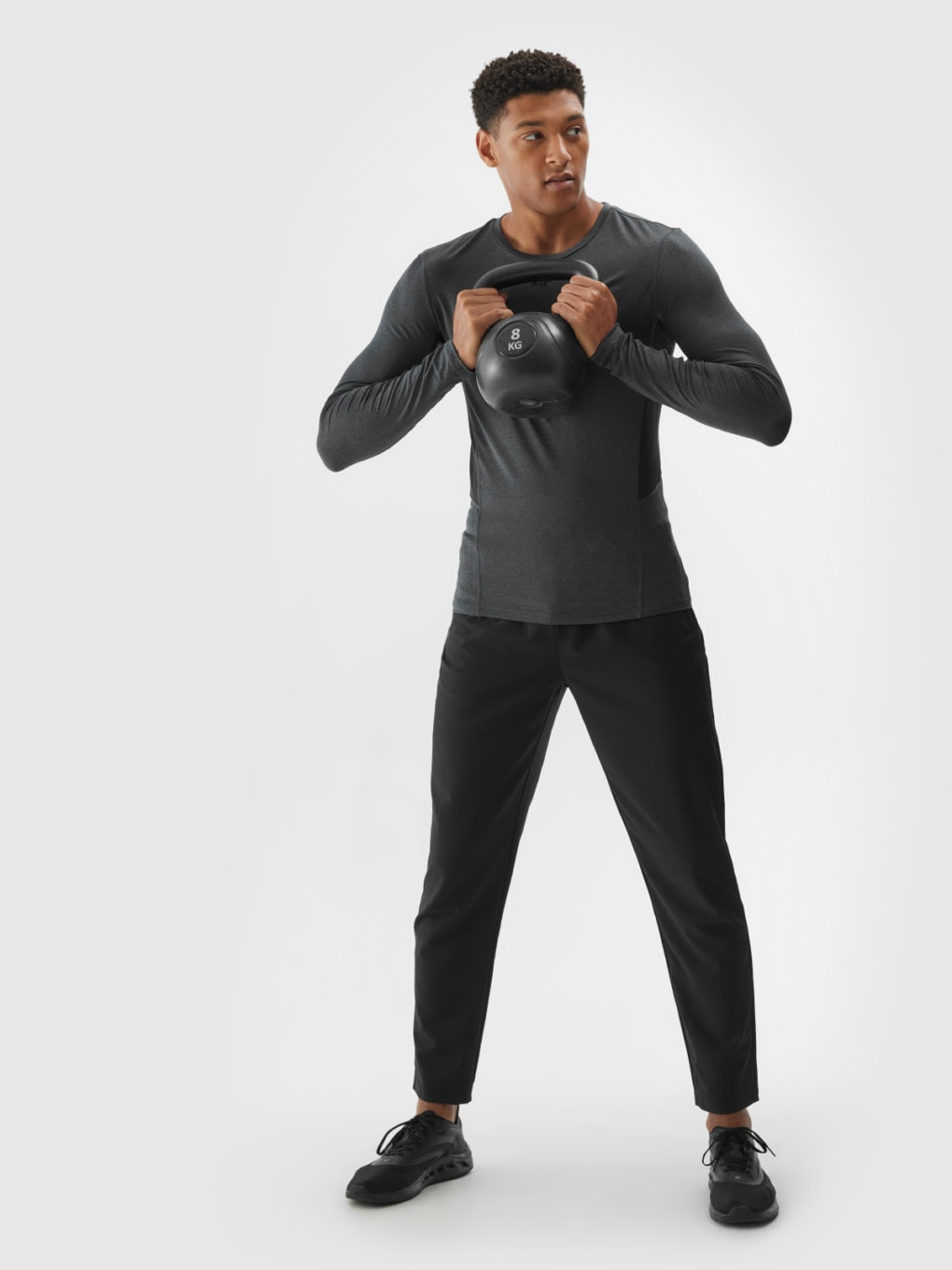
Not sure how to dress for a kettlebell training? Wear the same clothing you would for a regular strength training – a thermal shirt made of quick-drying fibres that does not cause chafing and allows unrestricted movements. Complete the look with comfortable shorts – women can swap them for leggings. Don't forget about comfortable sports shoes that keep your feet stable, which is essential to reduce the risk of injury. Women should also wear a functional sports bra that provides reliable bust support.
See other accessories for at-home workouts to quickly improve your strength and endurance.
Kettlebell training for beginners – exercises
Here is a set of basic kettlebell exercises that are suitable for both those starting their training journey and those who are already training, but this is the first time they work out with this equipment.
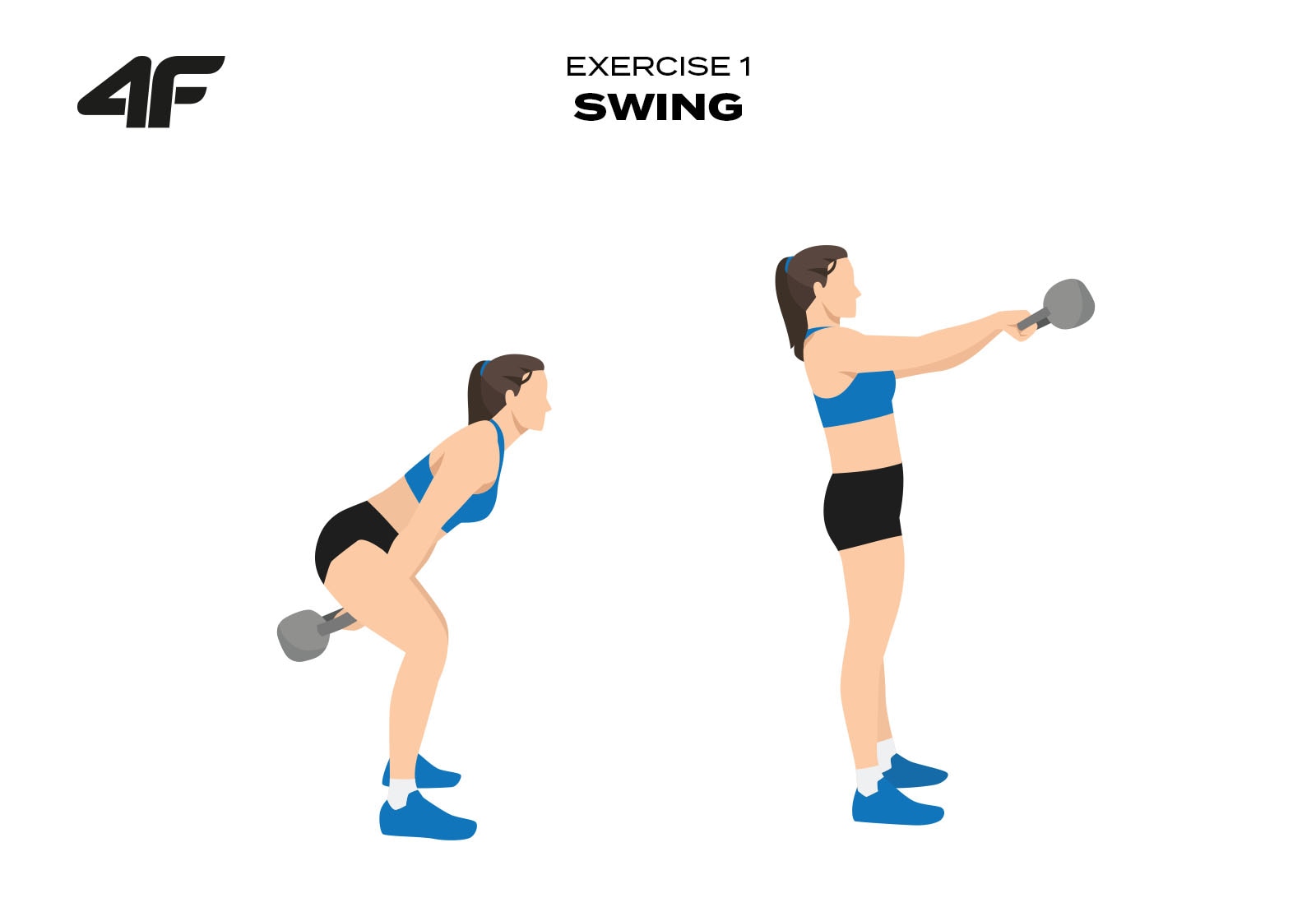
Exercise 1 – Swing
Stand with your feet wider than hip-width apart, with your knees bent ever-so-slightly. Grab the kettlebell with both hands and perform a slight backward swing so that the weight is between your legs (even slightly behind them), and then, thrusting your hips forward, drive the kettlebell forwards to chest height. Return to the starting position. It is important to maintain a straight back and keep your arms straight.
A single-arm kettlebell swing is also possible.
Exercise 2 – Clean
Stand with your feet wide apart, grab the kettlebell with one hand and swing it to position the weight between your legs. Then thrust your hips forward and propel the kettlebell up in front of you. Once it reaches the chest height, quickly bend your arm at the elbow so the kettlebell moves close to your body. The elbow should be positioned firmly against the chest and the kettlebell should be located on the outside of the hand. The other arm should be extended out to the side, helping you keep balance. Return to the starting position.

Exercise 3 – Military Press
Stand with your feet wide apart, grab the kettlebell with one hand, then swing it backwards between your legs and drive it forwards to the height of your chest, helping yourself with the hips. Move it closer to your chest, just like you would to in the Clean movement. Now lift your arm up, straighten it, hold for a brief moment, then bring your arm back to the chest. Staying in the position, repeat for a desired number of times.

Exercise 4 – Snatch
The exercise is similar to the Military Press, but differs in dynamics. Stand with your feet wide apart, grab the kettlebell with one hand, then swing the weight backwards and push it forward. However, don't stop around the chest — immediately bring your straight arm above your head. In the last phase of the movement, the kettlebell should be positioned behind your hand. Repeat the exercise on both sides.

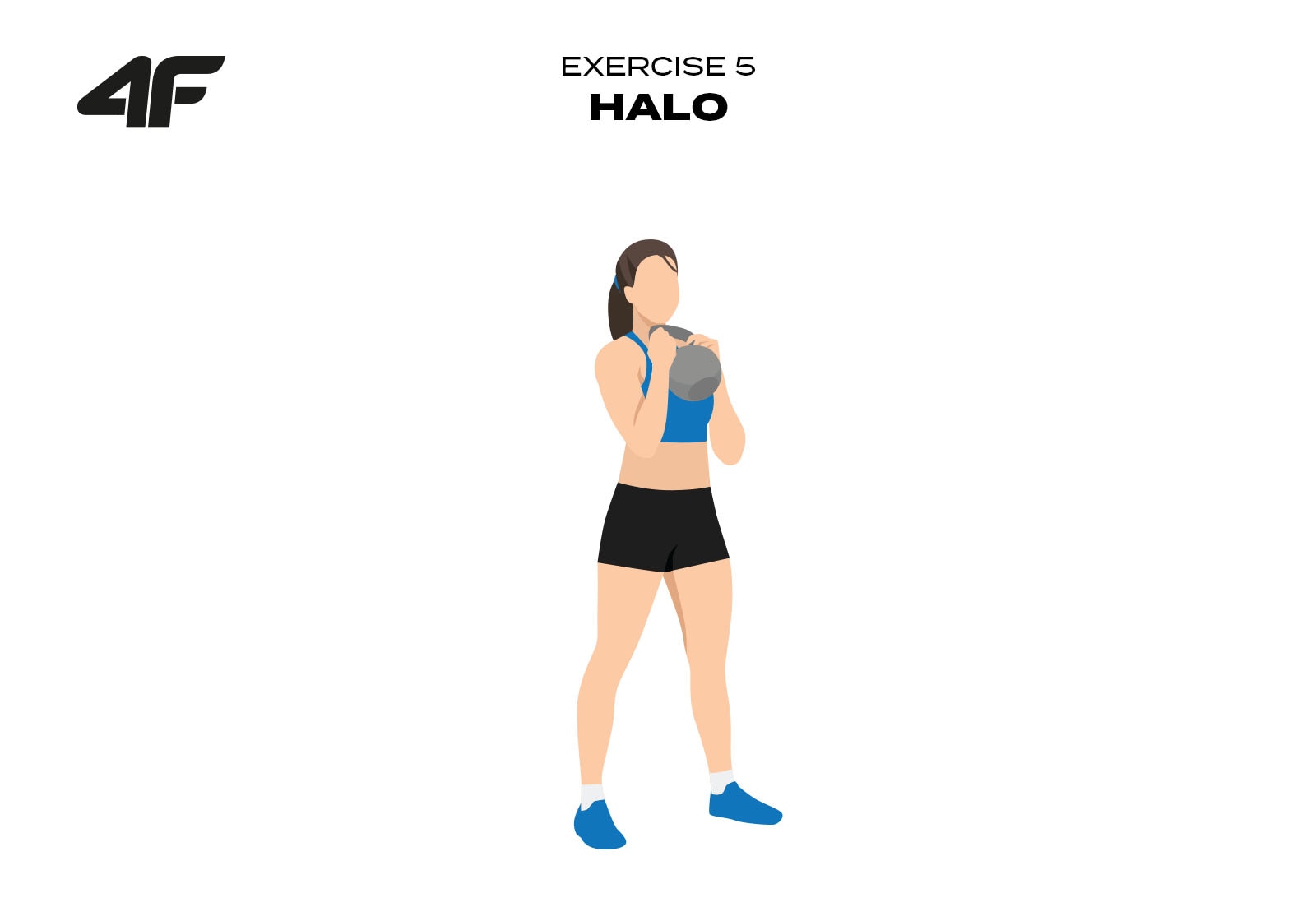
Exercise 5 – Halo
Stand with your feet wide apart, grab the kettlebell with both hands at chest height, keeping the equipment close to your body. Now, keeping your arms bent at the elbows, loop the kettlebell around your head, returning to the position at the other side. Perform alternately, changing the direction with each repetition.
Exercise 6 – Double kettlebell front squat
Stand with your feet wide apart and grab two weights in your hands – they should rest on the outside of your palms (with the kettlebells facing outwards). Now, keeping them close to your body, squat and push back up to the starting position.

Exercise 7 – Goblet squat
This exercise is a great starting point for your kettlebell leg workout. Stand with your feet slightly wider apart and grab the kettlebell, pulling it up to your chest, then perform a squat without changing the kettlebell’s position. Watch your knees – they shouldn’t track over your toes.

The above exercises are not enough? Watch a kettlebell circuit training performed by Marta Podkańska on our YT channel:
Kettlebell for everyone
Do you already know how to exercise with kettlebells? Remember that the most important thing is proper technique and building strong foundations. You can use the weights for strength training or to add variety to your general full-body workout. You can even use them to do sit-ups, push-ups, and many other exercises that are great for your health and figure.
See the best workout clothes and accessories to help you give it all.
-
https://www.health.harvard.edu/blog/should-you-try-kettlebells-2019021916025
-
https://sparcathens.com/the-science-behind-kettlebell-training/
-
https://pubmed.ncbi.nlm.nih.gov/22580981/
-
https://journals.lww.com/nsca-jscr/fulltext/2012/08000/kettlebell_swing_training_improves_maximal_and.28.aspx
Sources:
Popular on the blog
- 💡 Tips|🏋 Fitness
8 at-home exercises for perfectly sculpted ABS
Are you dreaming of visible, sculpted core muscles? To get there, you should introduce a properly developed ABS workout into your training routine – we've known for quite a while now that ordinary crunches
- 💡 Tips|🏋 Fitness
Water retention in the body and training - how to avoid retention
Do you train regularly, eat meals of calorie content that should lead to a gradual weight loss, and still your scale shows the same result? You increase the intensity and the frequency of your trainings,
- 💡 Tips|🏂 Winter sports|🔬 Technologies
How to choose a ski/snowboard jacket?
Before heading off to enjoy winter break, many of us wonder which ski jackets will be the best and which particular model will ensure thermal comfort and desired breathability. Sometimes we wonder whether
- 💡 Tips|🤸 Training plans
Exercises for seniors – a safeway to improve your fitness every day
Adulthood does not necessarily mean giving up physical activity. Quite the opposite! At this stage, sensible and regular movement becomes the best investment in everyday independence and well-being. Proper
Get to know sport inside out


